
Violet Technologies | Solo Founder, Fractional CEO
2023 - 2026
Impact
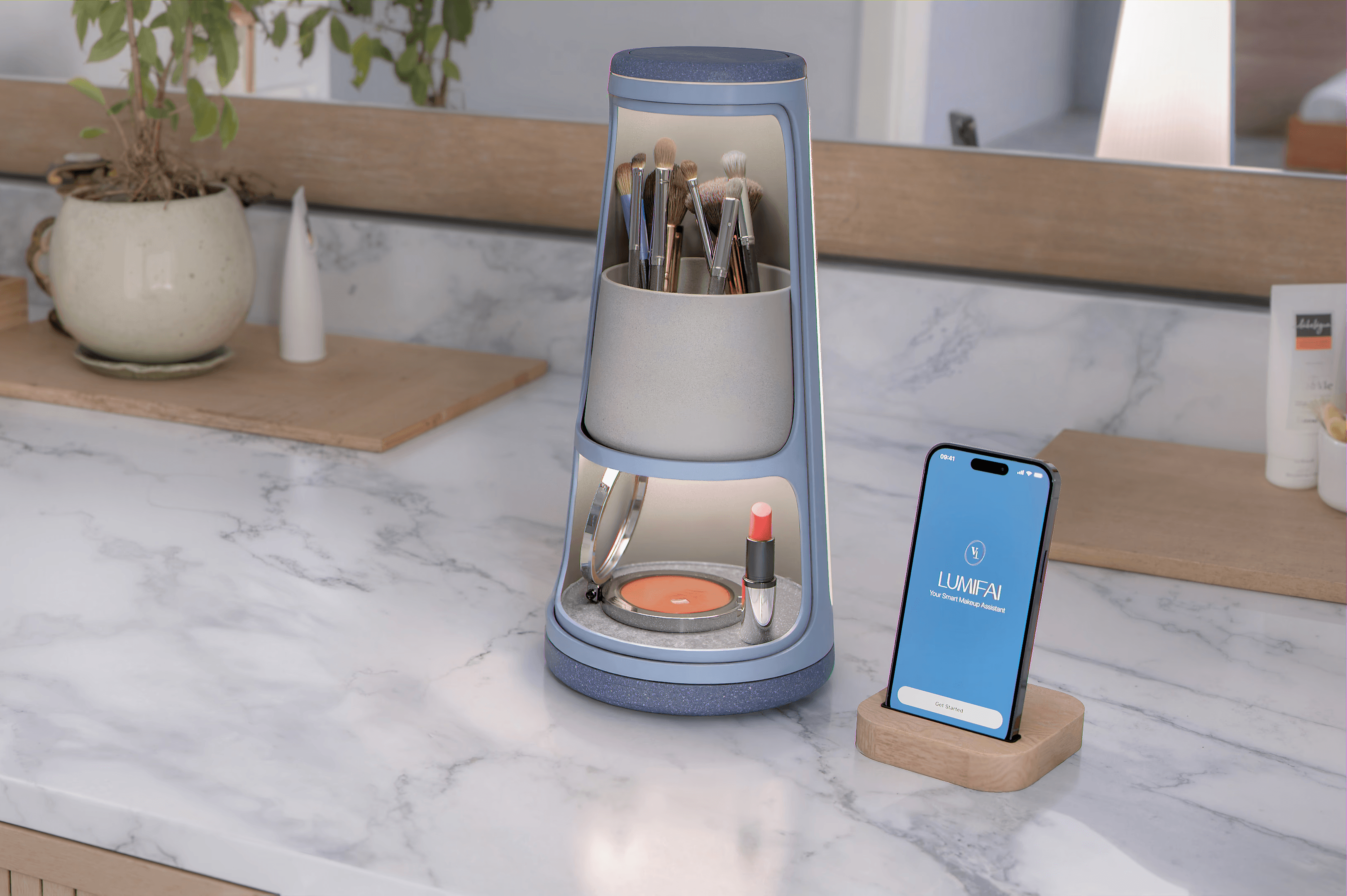
I secured $100K pre-seed funding and patent-pending IP by defining and validating a new product category in beauty. Led research, product strategy, validation planning, and fundraising for LUMI - a UV-C device that kills 99.9% of makeup bacteria in 2 minutes. Check out our website.
My Role: Solo Founder & CEO, Strategic Lead (fractional, 4 years)
Pitch video: Moenika explains Violet!
The Problem
The beauty industry has a contamination problem hiding in plain sight. Research shows makeup products harbor Staphylococcus aureus and E. coli, undermining the hundreds of dollars people spend on clean beauty and skincare routines.
But awareness isn't the issue—behavior change is. People know they should clean their makeup brushes. They just don't, because it takes 30 minutes every week and they're already rushing through their morning routine in under 5 minutes.
After years of struggling with acne, I finally figured out my dirty makeup brushes were the culprit. But even knowing this, I couldn't maintain weekly cleaning. That's when I realized: if hygiene requires effort, it won't stick. We needed to remove friction entirely.
The strategic challenge: Build contamination prevention into the routine itself, not as something extra to remember.
Research Strategy
I conducted 400+ user interviews and surveys to understand makeup habits, hygiene behaviors, and purchasing decisions. The most valuable insight came from a focused 6-week sprint - 32 interviews with women, men, and non-binary makeup wearers aged 26-52 across major US and UK cities.
I structured the interviews to move from broad routine mapping to specific pain points:
Weeks 1-2: Daily makeup habits and hygiene behaviors
Week 3: Social media influence and product trust
Week 4: Discovery channels and brand loyalty
Week 5: Price sensitivity and repeat purchases
Week 6: Emotional relationship with makeup (necessity vs. joy)
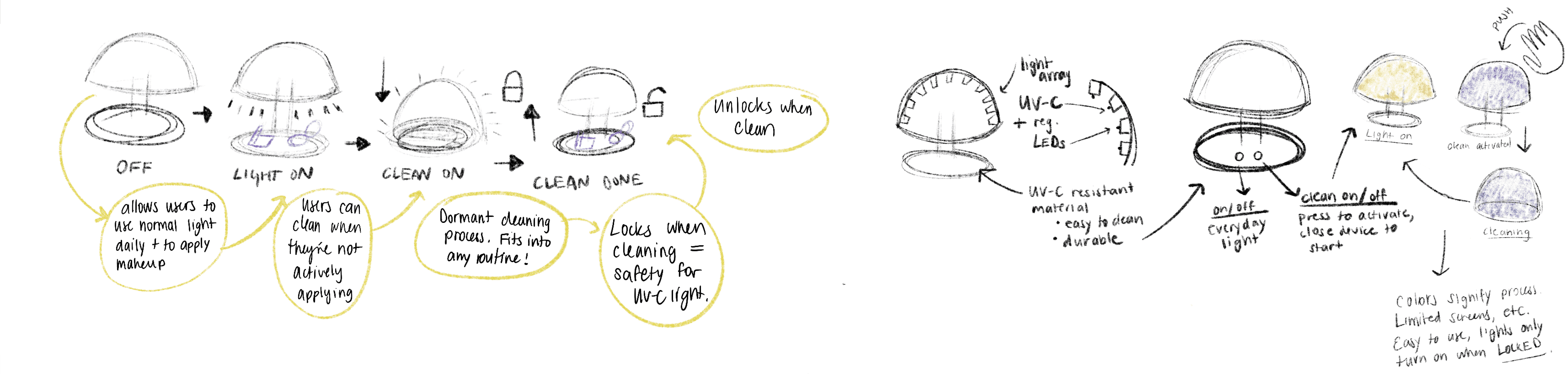
Initial sketch of the idea of Violet and its journey with the user.
Three Insights That Shaped the Product
Insight 1: Speed is non-negotiable
Users applied makeup in under 5 minutes, often while commuting or getting kids ready. Some kept makeup in their car. Weekly 30-minute brush cleaning doesn't fit this reality.
Implication: Whatever we built had to work in under 2 minutes, every single day.
Insight 2: Acne spreads through cross-contamination
People described a vicious cycle—using a brush on an acne spot, then spreading bacteria to clear areas of their face. The brush then contaminated their powder or foundation compact. Without cleaning both the brush and the product, the cycle never broke.
Implication: We couldn't just clean brushes. We had to address the full contamination loop.
Insight 3: Expensive products get zero maintenance
Users treated a $50 blush the same way they treated a $5 one—thrown in bags, used with dirty brushes, never cleaned. The investment didn't match the care.
Implication: Position this as "makeup maintenance," not cleaning. Make it about protecting investment, not adding a chore.
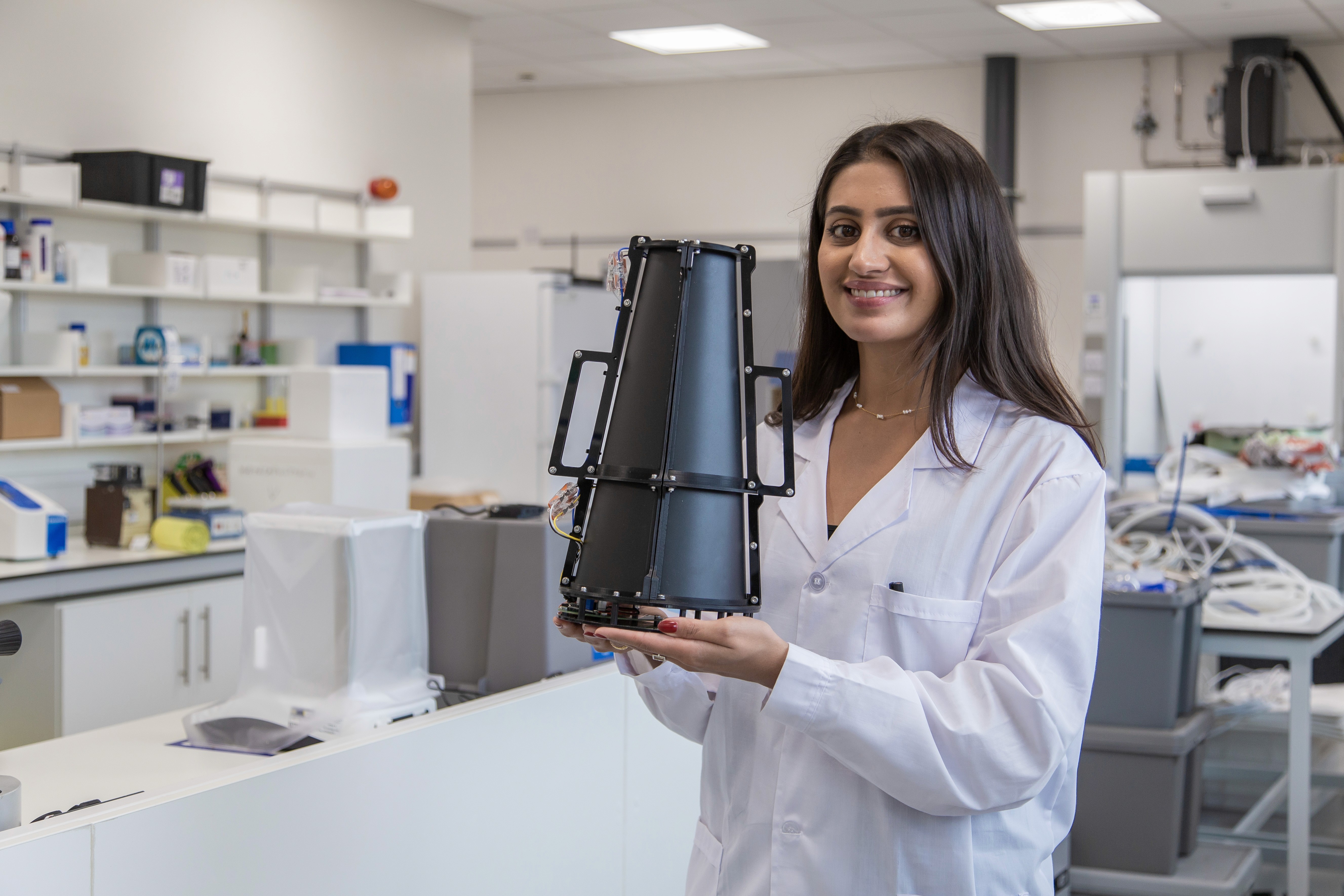
Moenika testing the MVP at MTIF in Nottingham, UK.
Key Strategic Decisions
Decision 1: Create a New Category
I tested three positioning approaches:
Option A: Group with skincare
Problem: Our product doesn't treat skin—it prevents contamination. The mental model didn't fit.
Option B: Market as a cleaning gadget
Problem: "Cleaning" implies effort and time. Gadgets are optional add-ons, not essentials.
Option C: Define "makeup hygiene" as its own category
This worked because it matched how people already think about their routine:
Skincare protects and treats
Makeup hygiene prevents contamination
Makeup enhances appearance
By creating a new category, we positioned LUMI as infrastructure rather than an accessory. This also strengthened our patent application—we weren't iterating on existing products, we were building something entirely new.
The risk: Category creation requires education. But we needed differentiation for both patent protection and investor narrative.
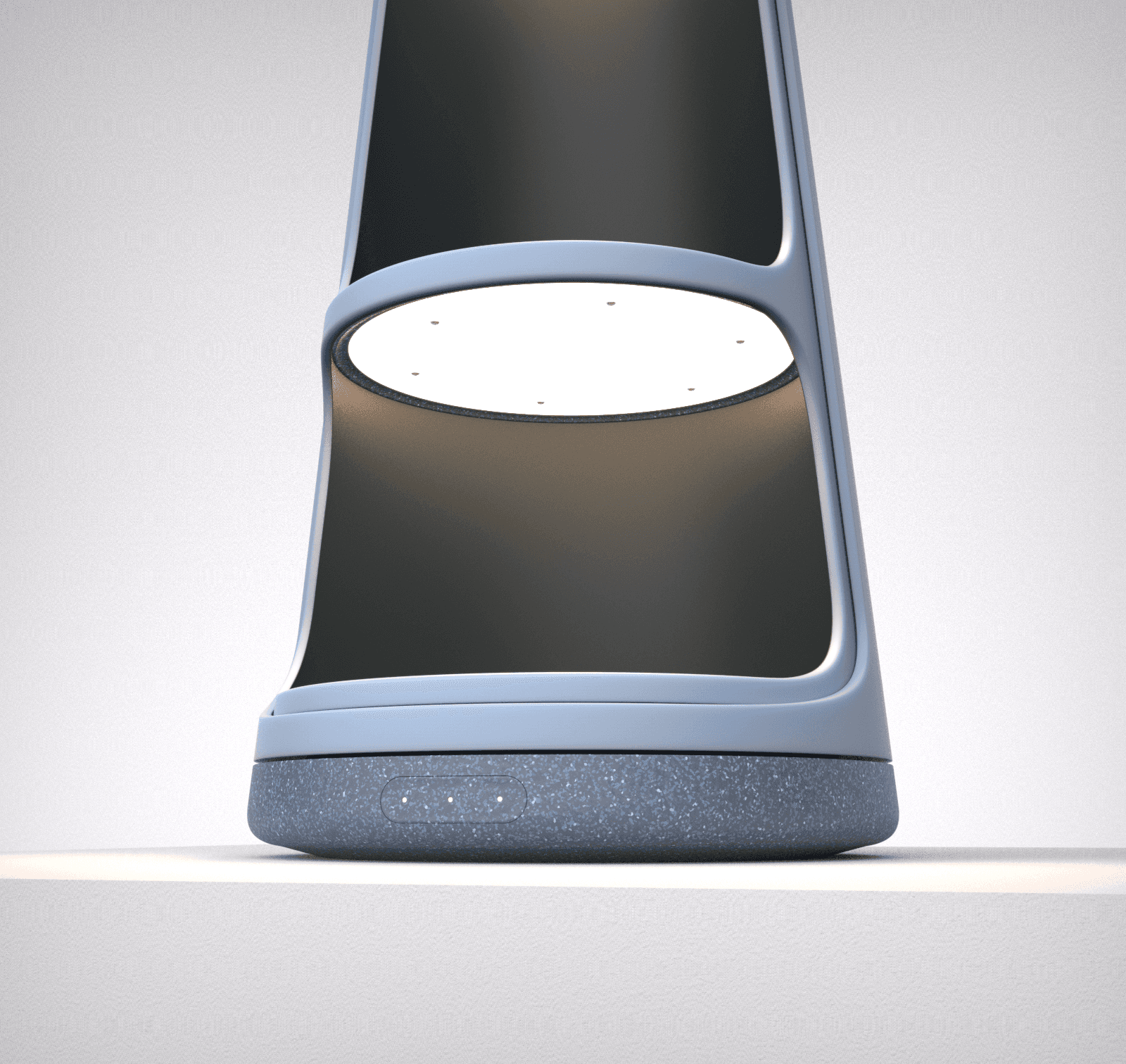
LUMI Render
Decision 2: The 2-Minute Bet (Speed vs. Efficacy)
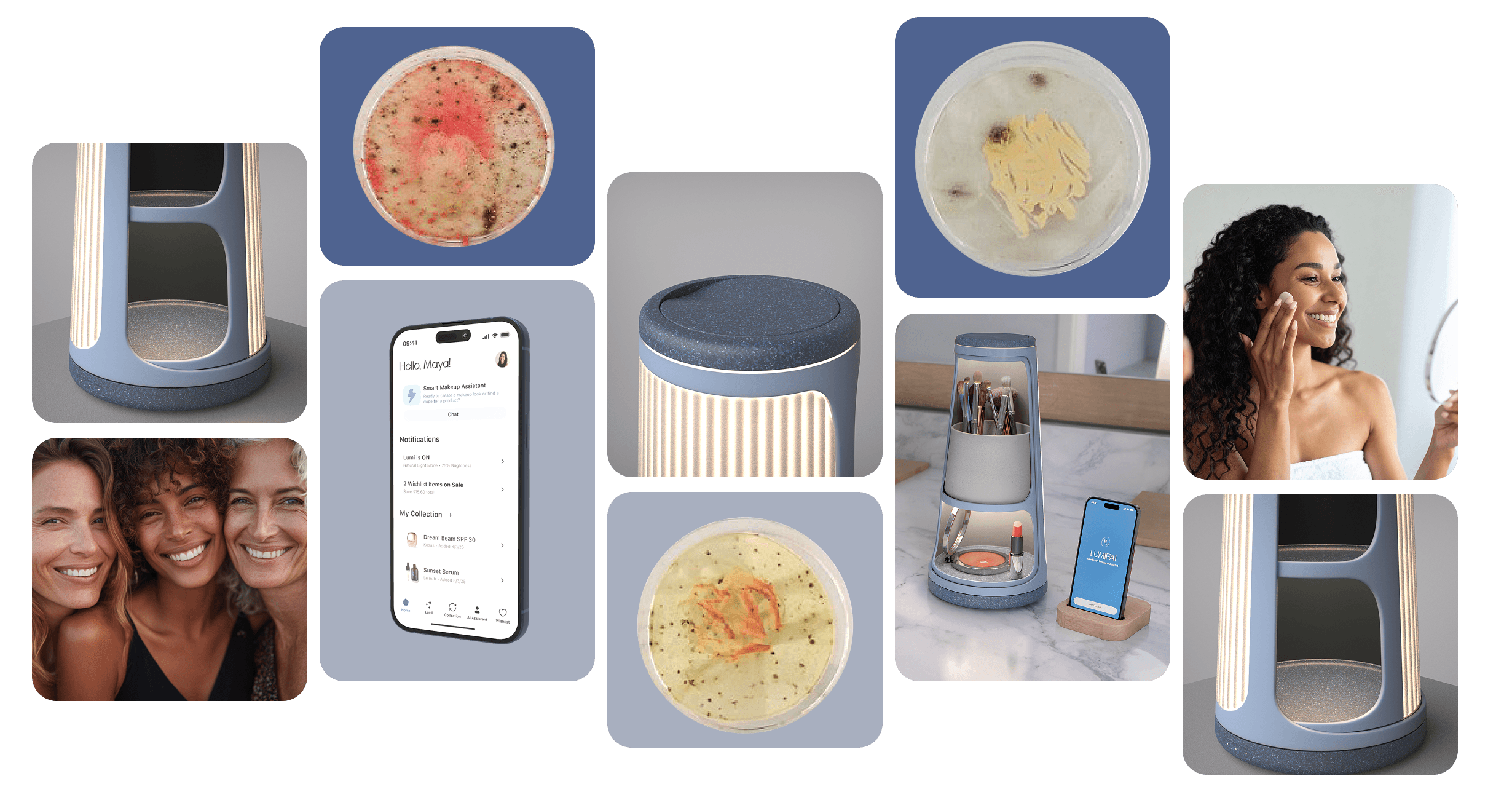
Lab testing at an independent facility in Nottingham, England showed bacterial elimination improved with exposure time:
2 minutes: 99.97%+ reduction
5 minutes: 99.99%+ reduction
10 minutes: No visible colonies
The scientifically optimal cycle was 10 minutes. But user research showed that anything over 2 minutes wouldn't become a daily habit.
I chose a 2-minute default cycle with optional longer modes.
Here's why: 99.97% reduction at 2 minutes cleared the scientific threshold for effectiveness. But more importantly, a 10-minute requirement would kill adoption entirely. Perfect efficacy at 10 minutes is worthless if users never turn it on.
The optional deeper cycles gave control to power users without blocking mainstream behavior change.
To de-risk this decision, I made sure the 2-minute cycle was independently validated so we could make credible marketing claims.
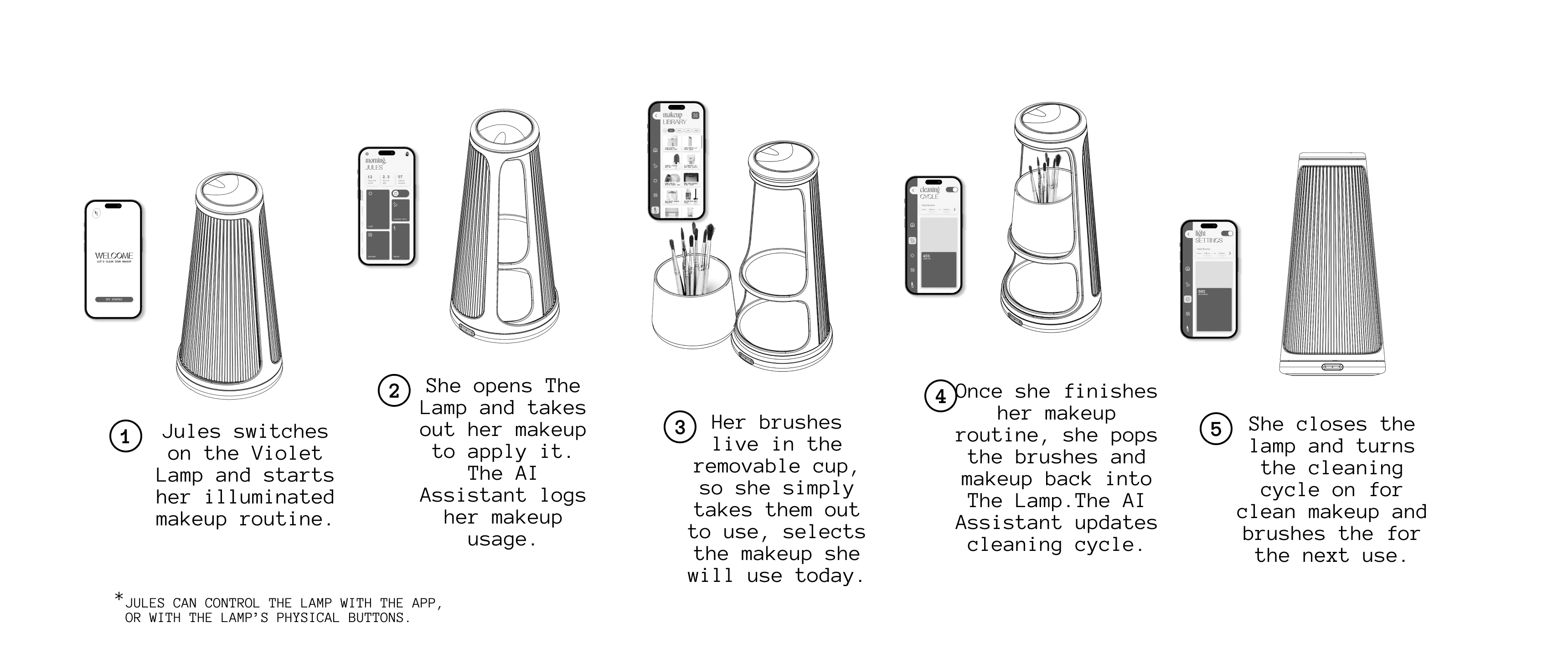
User Journey with LUMI & Lumifai
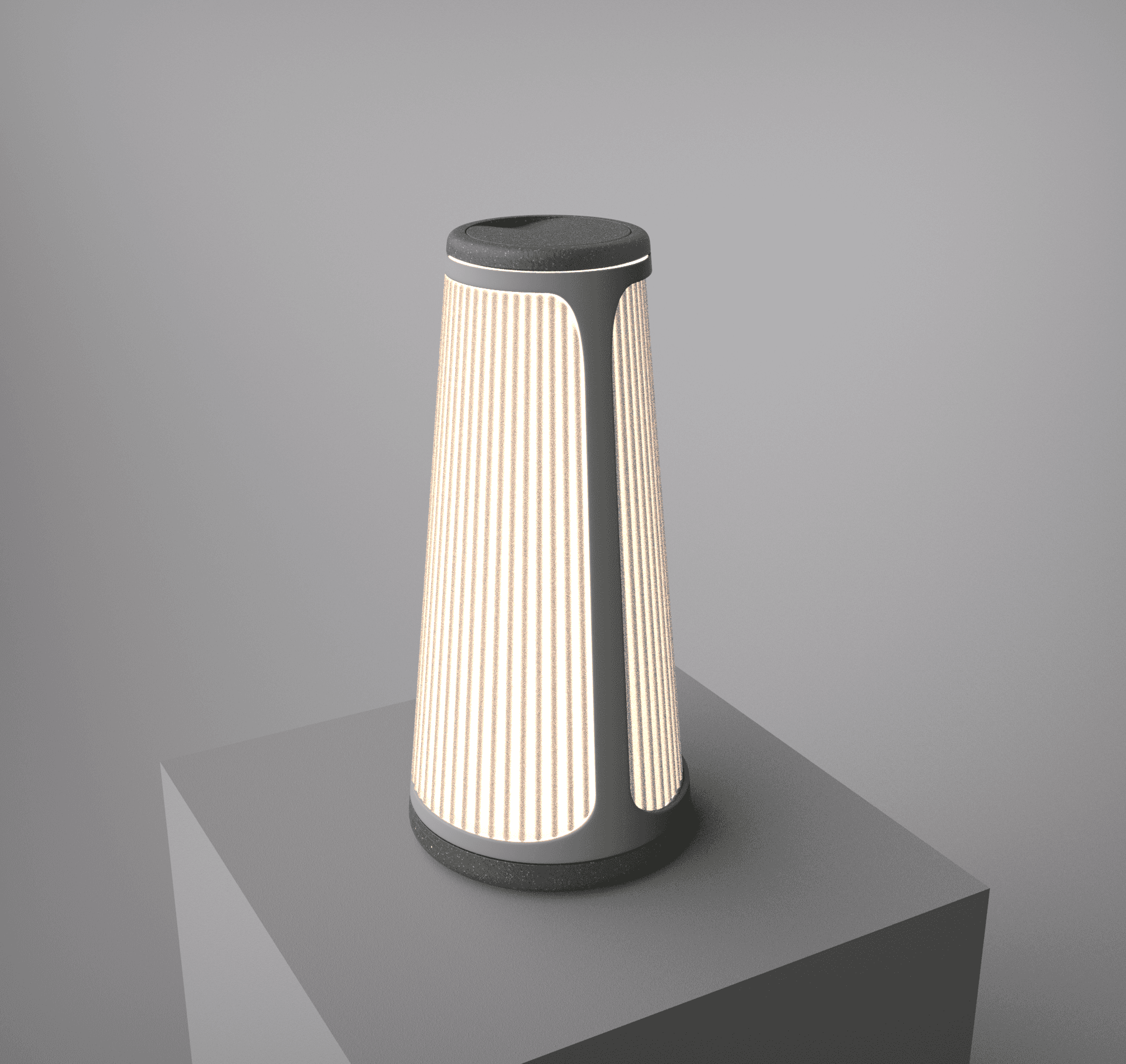
LUMI Render
Decision 3: Invest in Independent Validation Early
As a patent-pending innovation, we needed proof beyond my claims as a founder. I partnered with the Medical Technologies Innovation Facility (MTIF) in Nottingham to run testing using WHO benchmark organisms—E. coli and Staphylococcus aureus.
I designed the testing protocol with our microbiologist to answer specific questions:
What cycle times actually work?
What UV-C wavelength and strength do we need?
Can we make safety claims for marketing?
The independent validation gave us four things:
Investor credibility (contributed directly to the $100K raise)
Patent application strength
Product requirements (informed cycle time, UV-C array design, materials)
Marketing claim validation (99.97%+ reduction)
This was expensive upfront. But it removed the "prove it" barrier in every investor conversation and gave us a regulatory pathway from day one.
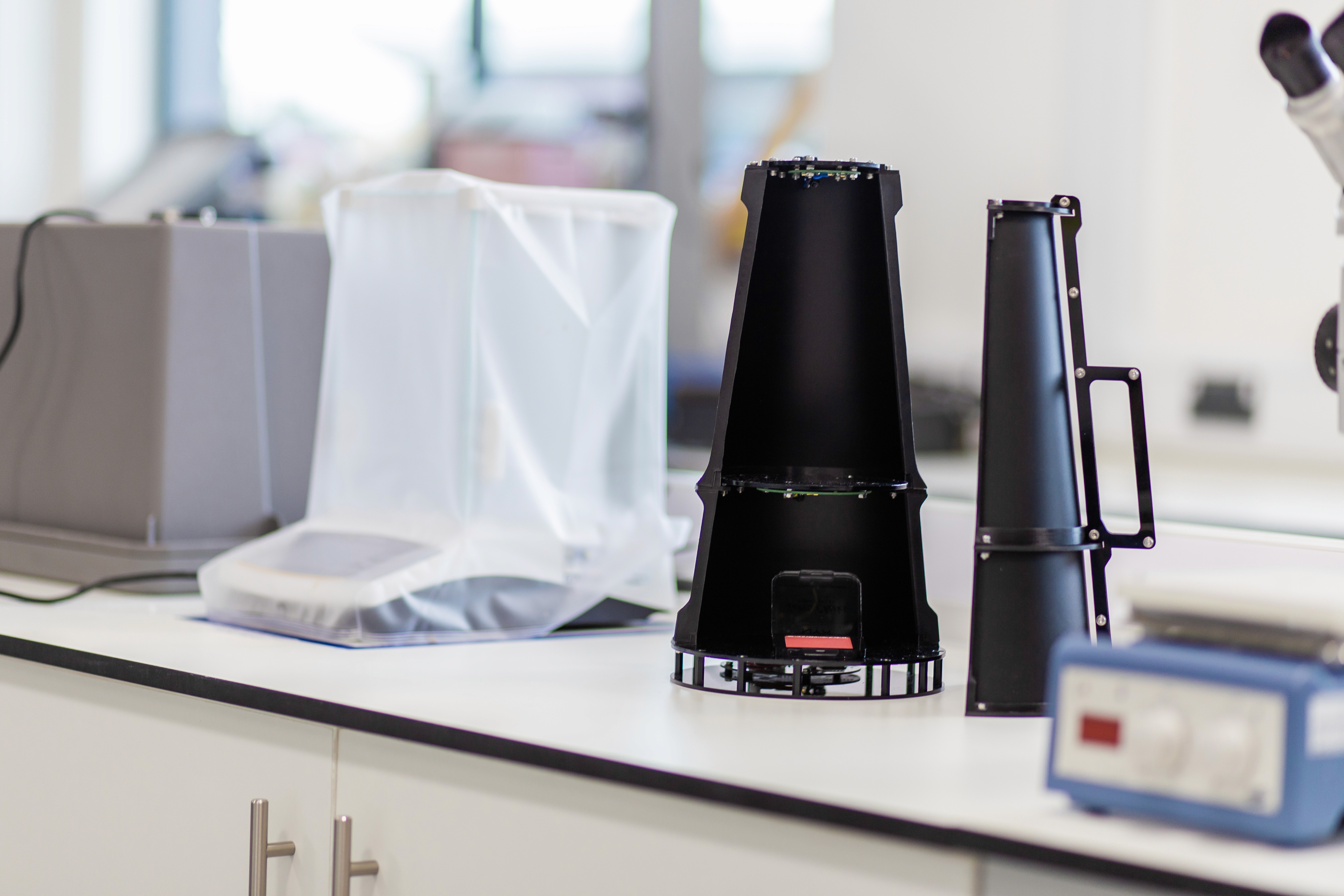
Testing prototype in the lab.
Decision 4: Build for Manufacturing from the Start
Most early-stage products get redesigned for manufacturing after launch. It's expensive and delays scale.
I hired injection molding specialists and electrical engineers before we even had a working prototype. We prioritized materials selection and DFM constraints alongside MVP development.
This avoided the trap of designing something beautiful but impossible to manufacture at scale. It also forced us to make hard trade-offs early—on materials, assembly complexity, and cost structure—when changes were still cheap.
As a solo founder, I had to recognize my blind spots. I needed experts in mechanical engineering, electronics, and microbiology. I created a 6-month roadmap with weekly 20-minute calls to keep everyone aligned. I owned requirements and timelines, but deferred to specialists on execution decisions.
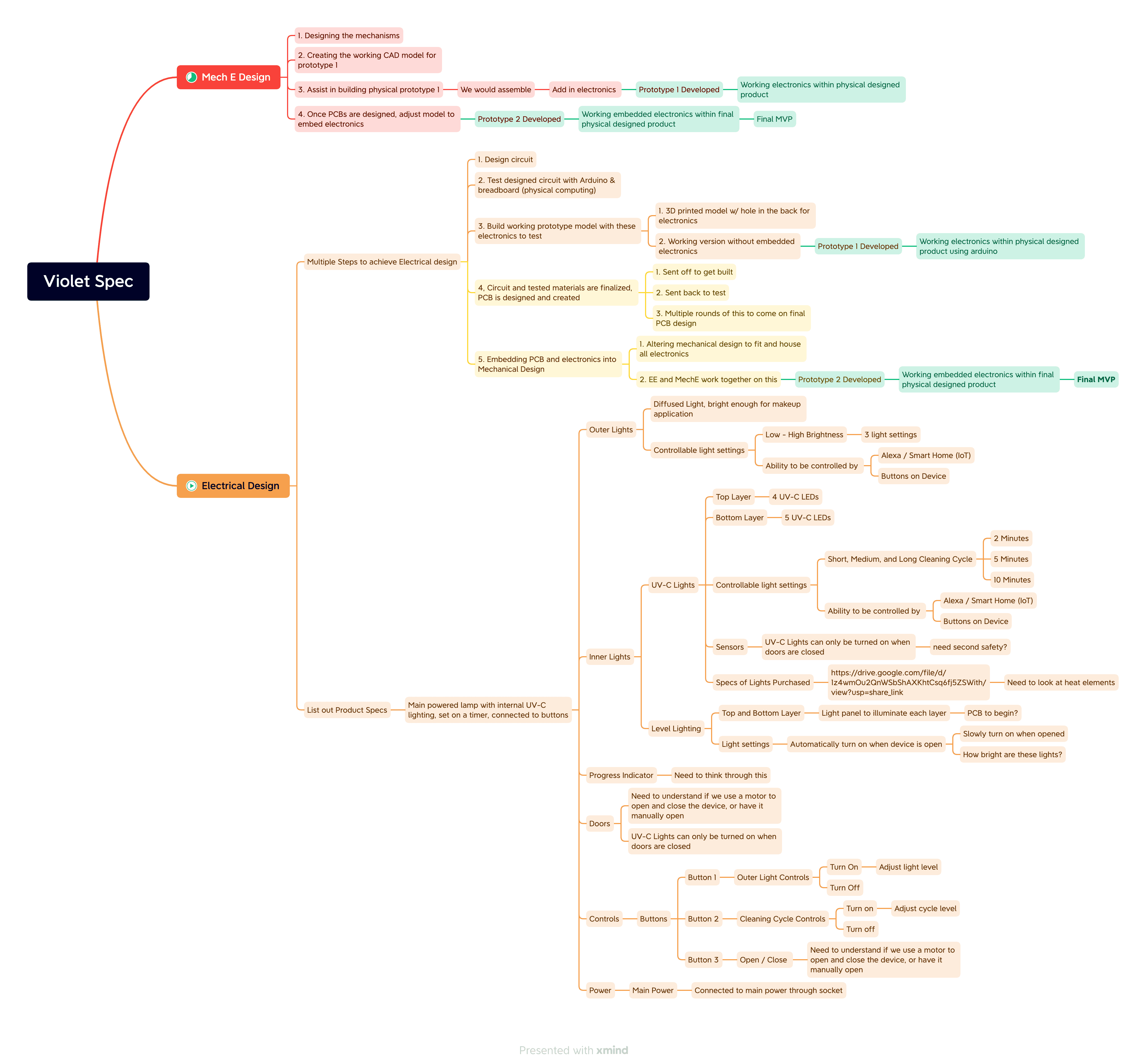
Spec document whilst designing how LUMI works.
What We Built
LUMI is a point-of-use UV-C vanity lamp that disinfects makeup brushes and products in 2 minutes. It integrates hygiene into the routine by serving three purposes:
Dual-shelf disinfection: Cleans both brushes and makeup (addresses full contamination cycle)
Everyday storage: Keeps products dust-free and organized (removes morning friction)
Vanity lighting: Functions as a lamp for the whole household (not just makeup wearers)
We also built Lumifai, an AI assistant that catalogs your makeup collection and gives recommendations based on what you already own. This reduces purchase fatigue and reinforces the "maintenance" positioning.
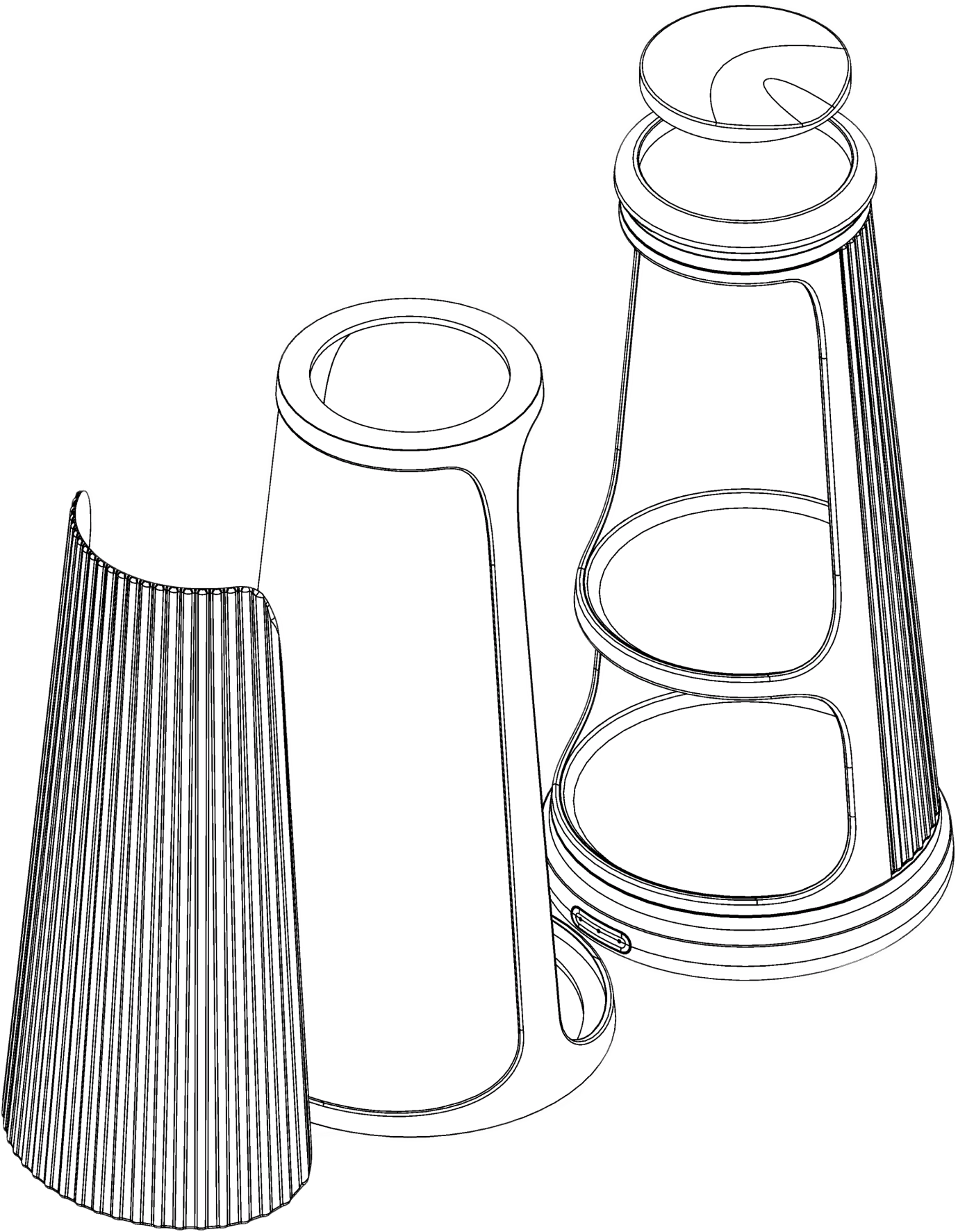
Patent Sketch, LUMI
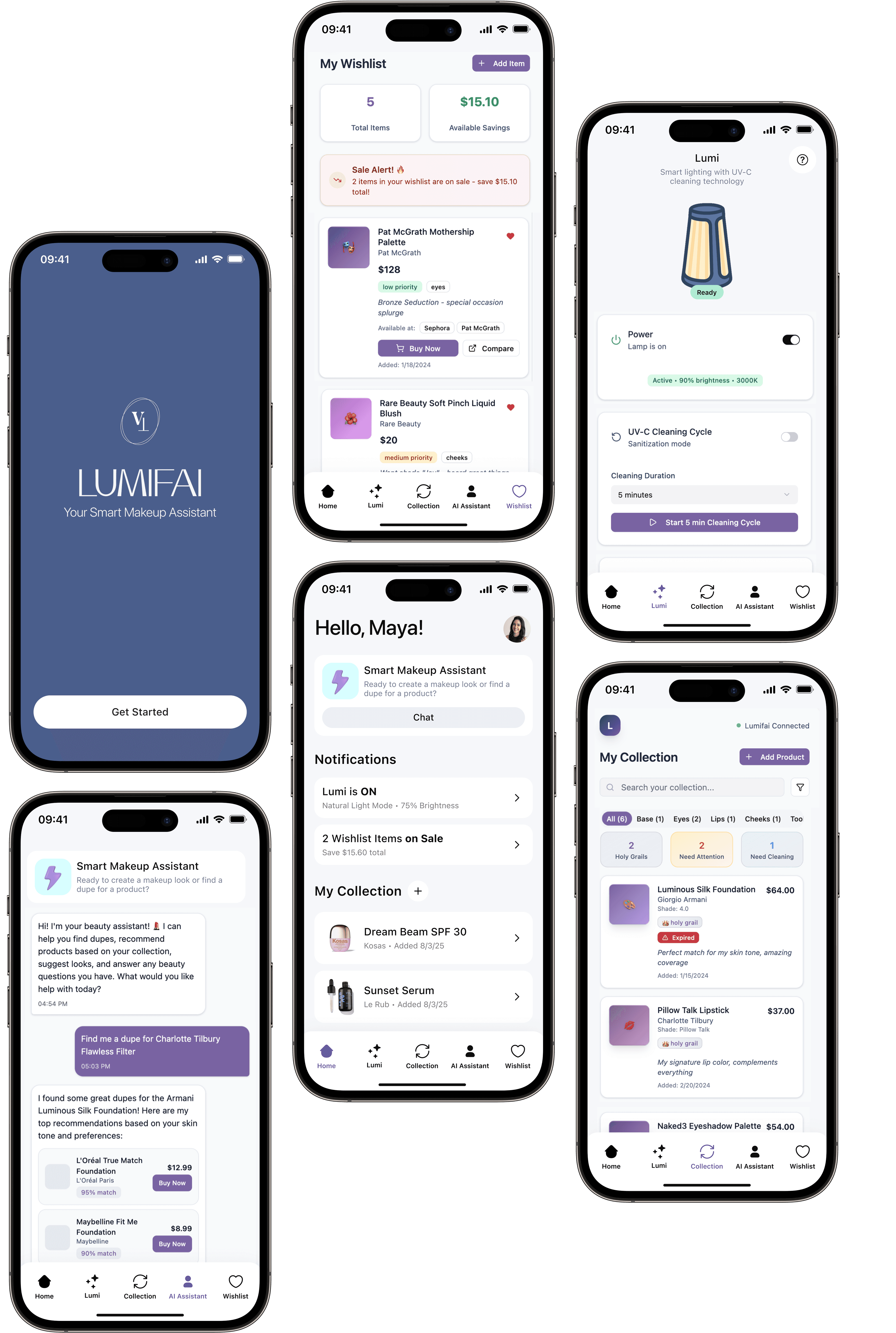
Paired app, Lumifai
User Profiles
Early Customer
Ages 26-40
Major USA cities
Medium to high income, disposable spending on makeup and skincare
Use makeup more than half the week
Struggled with acne or skin issues for years
Willing to try anything for clear skin
Trend-driven, buys new products
Active on social media
Ideal Customer
Ages 26-52
Major global cities (USA, UK, MENA, ASIA)
Medium to high income, disposable spending
Use makeup more than half the week
Want to invest in skincare, already spending hundreds
Had acne or skin issues in the past
Want to care for products they own, not just chase trends
Beauty enthusiast
Time-poor, want storage and cleaning solutions
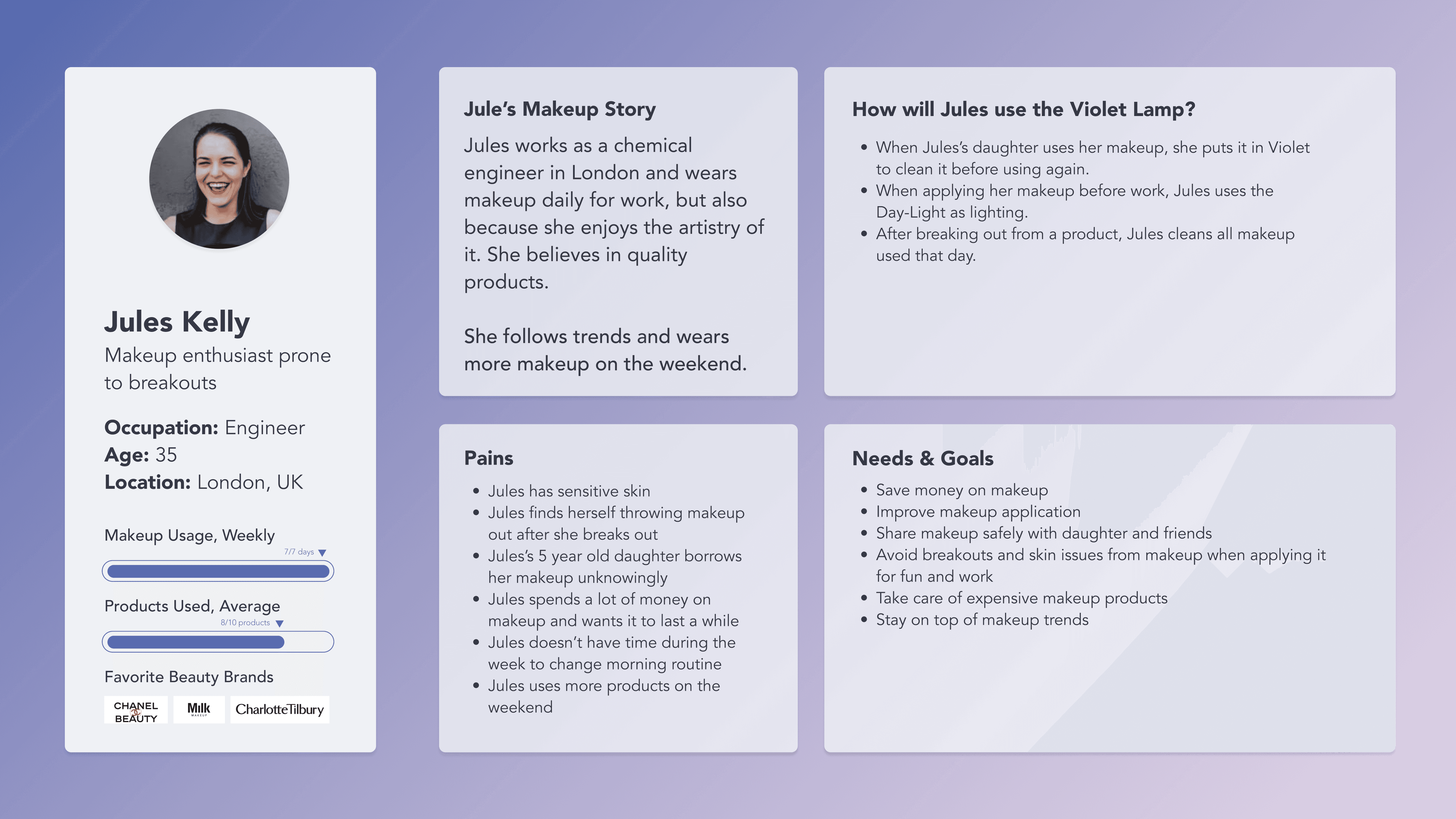
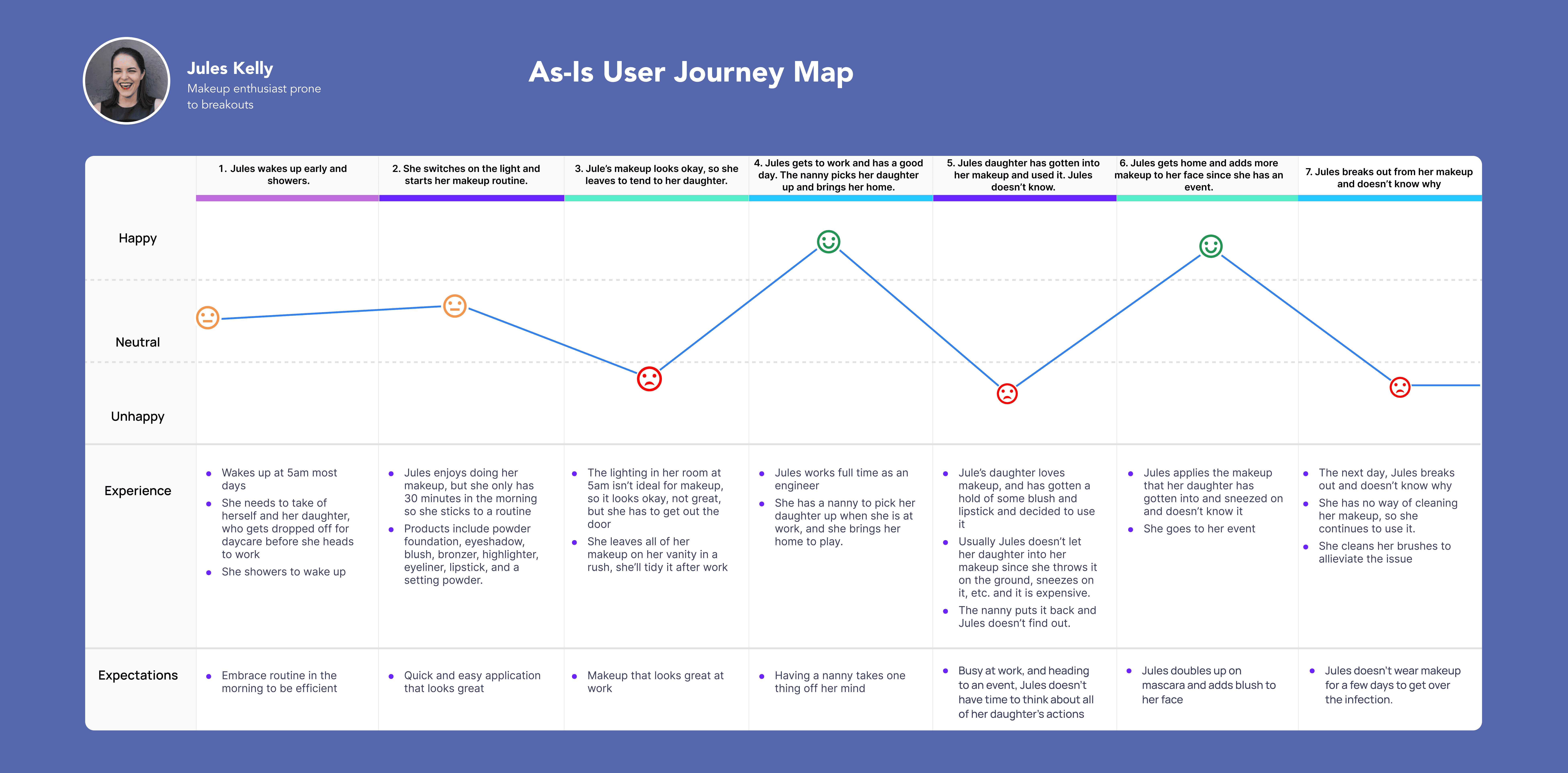
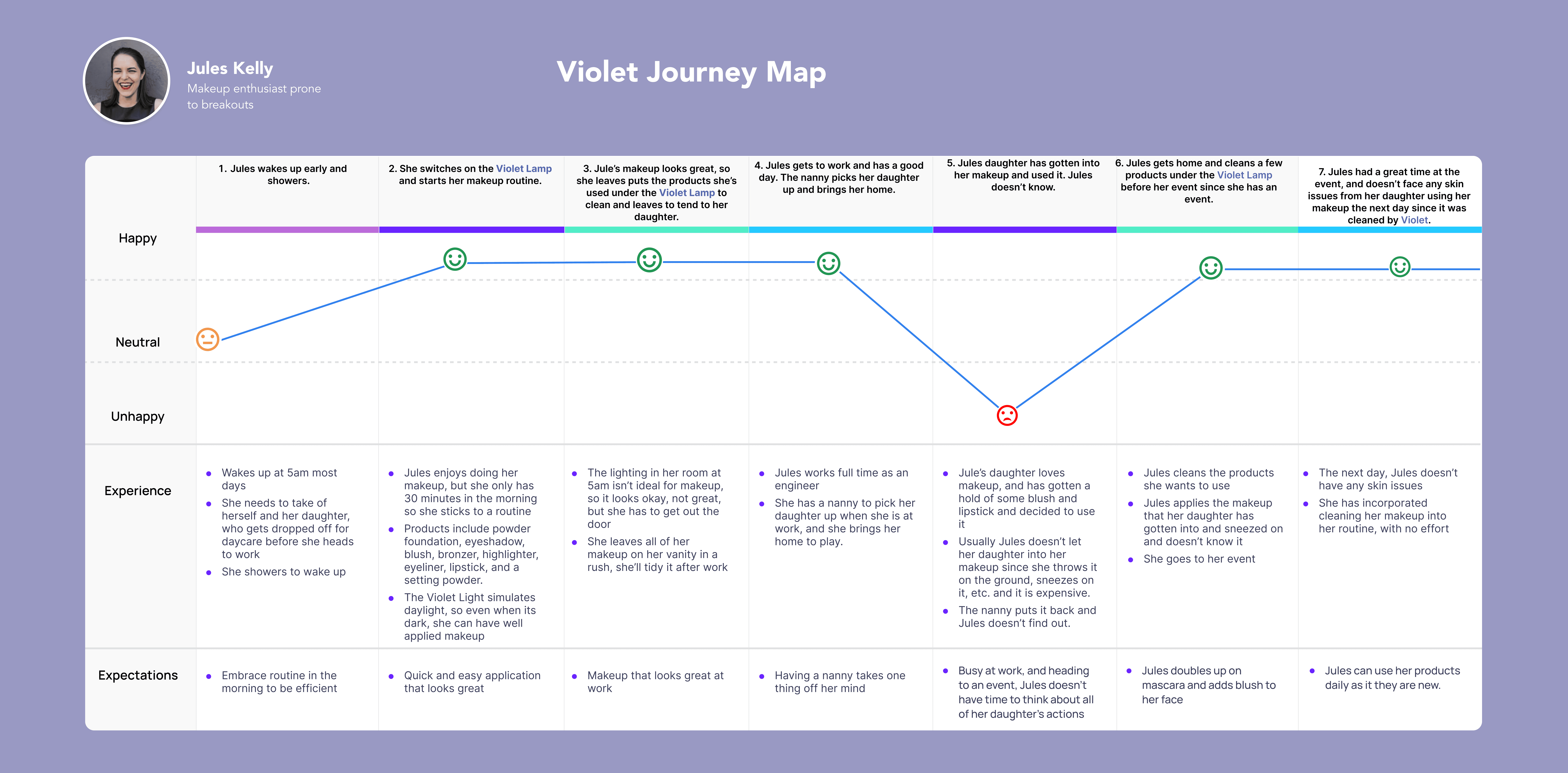
User profile for Jules & her As-Is and Violet Journey
Outcomes
Business impact:
$100K pre-seed funding secured (Prototypes for Humanity)
Patent-pending IP protecting the core innovation
Independent lab validation achieving 99.97%+ bacterial reduction
MVP advancing to design for manufacturing
Strategic impact:
Validated a new product category with investors and early users
De-risked technical claims through third-party testing
Built scalable manufacturing strategy from day one
Created a repeatable playbook for research-to-funding in hardware
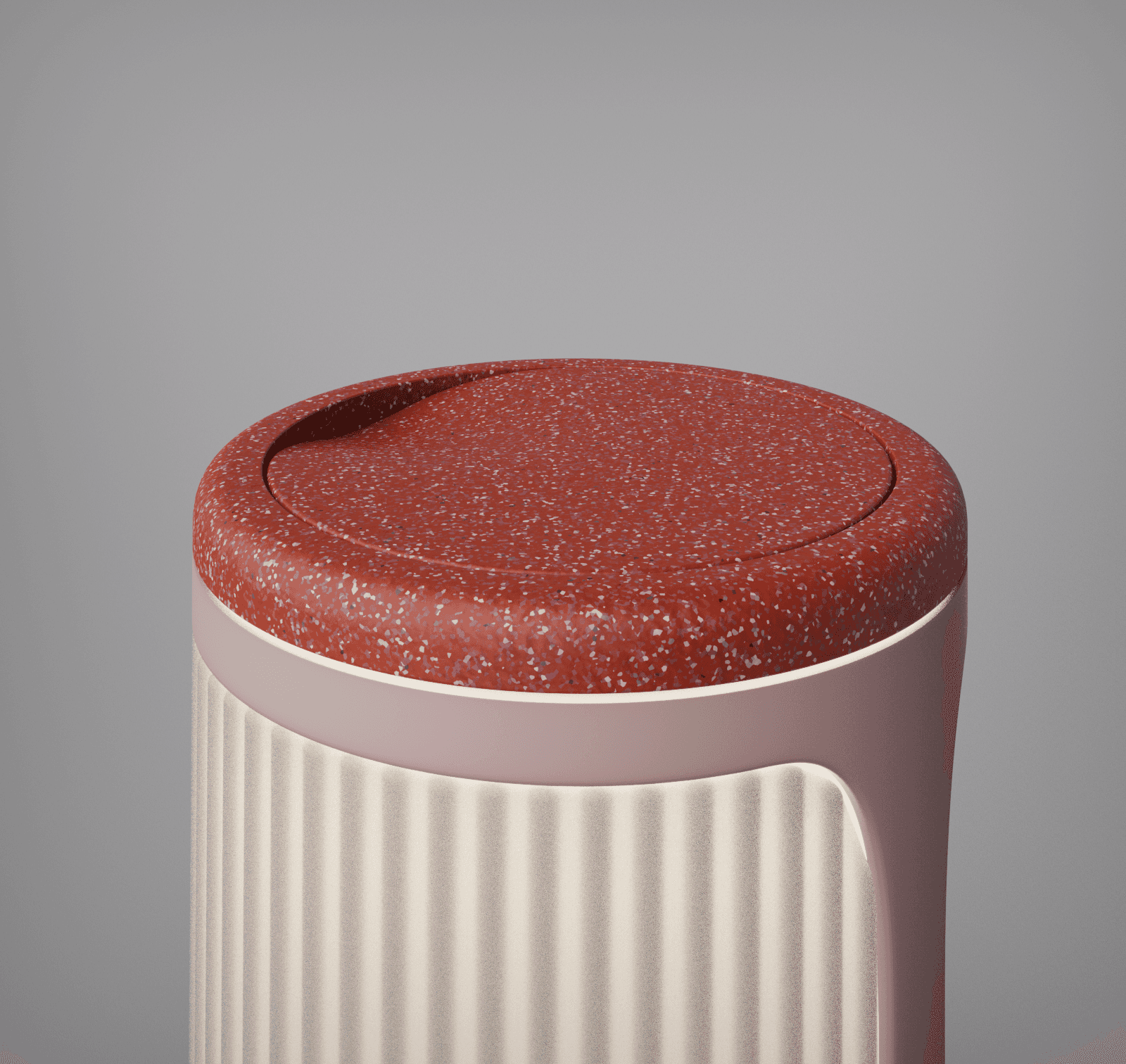
Render of LUMI
What I Learned
Category creation requires proof, not just vision.
Independent validation wasn't optional—it unlocked investor credibility and patent strength. In early-stage work, design strategy includes de-risking the narrative itself.
Strategic trade-offs beat perfect solutions.
The 2-minute cycle wasn't scientifically optimal, but it was strategically optimal. Knowing when "good enough" wins is what separates senior strategy from junior execution.
Research velocity matters in 0→1 environments.
The 6-week sprint gave us conviction to make bold bets quickly. In startups, speed plus depth beats exhaustive breadth.
What I'd do differently:
Rapid prototype multiple form factors with users earlier—would've saved months and money. Build social presence from day one instead of waiting for patent-pending status. Validate with beauty industry insiders sooner to temperature-check market readiness.